
Things to Do in Paramaribo in February
February weather, activities, events & insider tips
Low Season · Budget Friendly
February Weather in Paramaribo
Long-run averages for February
84°F (29°C)
High Temp
73°F (23°C)
Low Temp
5.8 inches (147 mm)
Rainfall
76%
Humidity
15
Rainy Days
13
Sunny-Day UV
⚠ Equatorial UV exposure is severe in February despite frequent cloud cover. The UV index reaches 13 on clear mornings, which is extreme by any global standard. Sunburn can develop in under 20 minutes of unprotected exposure, and the breeze off the Suriname River creates a false sense of coolness that masks how hard the sun is hitting. Cover up and reapply sunscreen constantly during morning outdoor hours.
⚠ Mosquito-borne illness risk is elevated during the wetter months. Dengue fever circulates in Suriname year-round, and February's rainfall creates standing water breeding sites throughout the city. Wear repellent from late afternoon onward, sleep under netting or in screened rooms, and seek medical attention promptly for any high fever with joint pain during or after your trip.
Making the most of February in Paramaribo? Browse tours and activities in Paramaribo on GetYourGuide.
Is February Right for You?
Weigh the advantages and considerations before booking
Advantages
- + February marks the start of Suriname's kleine droge tijd, the short dry season. Rainfall drops from January's 6.8 inches (173 mm) toward March's 5.1 inches (130 mm). Mornings stay clear and warm. Afternoon showers hit hard but brief, not all-day grey. The Suriname River runs high. Boat excursions into the Commewijne district prove easy to navigate. Skip the silted-up low-water headaches of September and October.
- + Carnival season hits Paramaribo's streets like nothing else. Pre-Lenten celebrations pull every community into the open. Maroon drum corps, Javanese dance troupes, Hindustani brass bands, and Creole masquerade groups converge along the Waterkant. They move through the wooden colonial grid of the UNESCO-listed inner city. The energy feels local. It is not packaged for tour groups. Fried barra dough and charcoal-grilled chicken satay from sidewalk vendors saturates entire blocks. The smell alone justifies the trip.
- + Crowd pressure barely registers by any international standard. Suriname ranks among South America's least-visited countries. February attracts a fraction of already modest annual arrivals. Fort Zeelandia, the Palmentuin, the Saint Peter and Paul Cathedral, the synagogue-mosque pairing on Keizerstraat: expect Dutch gap-year travelers and occasional birding groups. No coach tours. Unhurried access follows. Locals still have patience to talk.
- + February humidity hovers around 76%. That beats the 88% of May or June. The Suriname River breeze picks up evenings along the Waterkant promenade. Perceived temperature drops enough for cold Parbo beer outside after dark. February nights cool to around 23°C (73°F). Sleep without air conditioning becomes possible. Your guesthouse needs decent airflow.
Considerations
- − Fifteen days of measurable rain in a 28-day month means you will get wet. Tropical showers pass within 30 to 45 minutes. They can turn violent. Gutters overflow. Unpaved streets in Latour or Blauwgrond become ankle-deep mud within minutes. Full-day outdoor excursions to Brownsberg Nature Park, roughly 130 km (81 miles) south, require accepting a soaking as part of the deal.
- − Mosquitoes attack aggressively in February. Standing water collects in drainage channels after rain. Paramaribo sits at tropical latitude. Dengue circulates year-round in Suriname, transmission rising in wetter months. Apply DEET-based repellent religiously from late afternoon onward. Avoid accommodations without screens or netting entirely.
- − International flights into Johan Adolf Pengel International Airport stay limited and pricier than expected. Most connections route through Amsterdam on KLM or through Port of Spain and Georgetown on Caribbean carriers. February scheduling creates awkward layovers. The airport sits about 45 km (28 miles) south of the city center. The drive through Zanderij takes a good hour. Land during the afternoon rain window and add time.
Settled on February? Compare hotel prices in Paramaribo for your dates on Trip.com.
Best Activities in February
Top things to do during your visit
February sits in the lull between Suriname's two rainy seasons, and Paramaribo wears the pause well. Afternoon highs settle around 84°F. Warm enough that the wooden colonial facades along Waterkant radiate stored heat long after sundown. The nights ease to a walkable 73°F with air that smells of river mud and frangipani. Rainfall averages about 5.8 inches for the month, noticeably lighter than the deluge that arrives in April and May. Mornings often open clear and bright before clouds gather in the late afternoon for a short, theatrical downpour. It drums on the corrugated roofs of the Central Market and sends everyone under the nearest awning for ten minutes of enforced stillness. The capital's layered identity is sharpest in the cooler morning hours. Javanese warungs on Dominéstraat already fill the street with the perfume of bami and soto. Hindustani roti shops on Maagdenstraat press dough flat on searing griddles. Creole vendors at the Markt squeeze tart, cold dawet from coconut milk and pandan. Paramaribo is a city you navigate by scent as much as by street sign. The Suriname River runs wide and brown at the foot of Waterkant, and in February the water level sits low enough to expose the mudflats where white egrets stand motionless at dawn. Nightlife in Paramaribo concentrates around the Waterkant strip and a handful of rum bars in the Combé neighborhood. Speakers push kaseko rhythms out into humid side streets, and the sharp sweetness of Borgoe rum carries from every open doorway. Safety in Paramaribo follows the pattern of most South American capitals. The historic inner city and the waterfront are well-lit and walkable after dark. Travelers should stay alert in quieter residential areas and avoid the Frimangron neighborhood at night. Hotels in Paramaribo range from converted plantation houses on Gravenstraat to modern guesthouses near the river. February's moderate weather makes any location comfortable as long as you have a ceiling fan or air conditioning to counter the midday warmth. Restaurants cluster in the Waterkant district and along Kleine Waterstraat. The best eating often happens at the simplest stalls, where a plate of Javanese nasi goreng or a Hindustani bara arrives hot, greasy, and extraordinary. Beaches near Paramaribo require a drive north to the Weg naar Zee coast road. The sand is brown and the Atlantic water is silty. The emptiness is total.

Paramaribo City Tour
guided_experienceThe Paramaribo City Tour walks you through the UNESCO-listed wooden inner city at a pace that lets you absorb the incongruity of a Caribbean capital where a Dutch-colonial synagogue stands wall-to-wall with a Hindustani mosque. The air between them smells of cumin and old teak. Your guide traces the route from the white-painted Presidential Palace to the fortress of Fort Zeelandia. The thick laterite walls still hold the cool damp of centuries, and the river breeze carries the mineral tang of the Suriname. The tour threads through the Central Market, where stacked cassava, bitter melon, and purple yams gleam under corrugated tin. Vendors call out in Sranan Tongo while ceiling fans push the sweet rot of overripe mango through the aisles.
Paramaribo's colonial wooden architecture is the only UNESCO World Heritage ensemble of its kind in the Caribbean, and this guided circuit decodes its layered cultural geography in a single morning.
Insider tip: Ask your guide to detour through the courtyard behind the synagogue, where a centuries-old mikveh sits half-hidden behind a wall, and the light filters down through palm fronds onto worn brick in a way that rewards a slow photograph.

Full-Day Brownsberg Nature Park Tour
day_tripThe Full-Day Brownsberg Nature Park Tour climbs from the coastal plain into the interior highlands. The Mazaroni Plateau drops away in a curtain of green, and the Irene Falls plunge into a granite basin loud enough to drown out conversation. The forest at Brownsberg is dense lowland rainforest transitioning to montane. The canopy closes overhead so completely that the air beneath is ten degrees cooler and thick with the musty, loam-rich smell of decomposing leaves and wet epiphytes. Howler monkeys announce themselves from the treetops with a sound more felt than heard, a low, vibrating groan that rolls across the valley. Toucans flash their absurd orange bills between branches.
Brownsberg is the most accessible primary rainforest from Paramaribo, and the viewpoint at the plateau rim gives an uninterrupted horizon of canopy stretching to the Brazilian border with not a single structure in sight.
Insider tip: Wear shoes that can handle mud and standing water on the trail to the falls, and bring a dry bag for your electronics because the spray at the base soaks everything within five meters.
This month: February's lower rainfall means the trails at Brownsberg are less waterlogged than in the May-through-July wet season, when some paths become knee-deep channels, though the falls still run with enough volume to feel the mist on your skin from the viewing platform.

Sunset and Dolphin Tour Suriname
guided_experienceThe Sunset and Dolphin Tour launches from the banks of the Suriname River in the late afternoon. The water turns from brown to copper, and the sky above Paramaribo goes through a slow gradient of peach, violet, and charcoal. Guiana dolphins surface in the estuary where the river meets brackish tidal water. Their grey backs arc just long enough to catch the last light before they slide back under. The silence between surfacings is broken only by the slap of small waves against the hull and the distant call of scarlet ibises heading to roost. The air cools rapidly once the sun drops, and the salt-and-silt smell of the estuary sharpens as the boat drifts with the current.
This is the only reliable way to see Guiana dolphins near Paramaribo, and the quality of the equatorial sunset over flat water and mangrove is worth the trip on its own.
Insider tip: Sit on the port side of the boat heading downriver for the best angle on the sunset, and bring a light jacket because the breeze off the water after sundown raises goosebumps fast.

Bigi Pan Tourist Eco Lodge
guided_experienceBigi Pan Tourist Eco Lodge sits at the edge of the Bigi Pan wetland, a vast tidal swamp west of Paramaribo where mangrove channels open into shallow lagoons packed with scarlet ibises, snowy egrets, and capped herons. The boat ride to the lodge passes through corridors of black mangrove so narrow the branches scrape the gunwales. The water underneath is clear enough to see juvenile tarpon finning in the roots while the canopy filters the light into shifting green and gold. At dusk, thousands of scarlet ibises return to roost in the mangroves. The collective sound of their landing, a dry rustling like shuffled paper amplified a thousandfold, fills the air while the trees turn an improbable red against the fading sky.
Bigi Pan holds one of the largest scarlet ibis colonies in South America, and the overnight stay means you witness both the evening roost arrival and the dawn departure, two of the most concentrated bird spectacles on the continent.
Insider tip: Bring binoculars with at least 8x magnification and a headlamp for the pre-dawn boat launch, and wear long sleeves treated with permethrin because the mosquitoes at dusk in the mangroves are relentless.
This month: February's drier conditions mean the water level in Bigi Pan's channels sits lower, concentrating wading birds into tighter feeding areas and making the ibis roost denser and easier to observe from the boat.
Where to Stay in Paramaribo in February
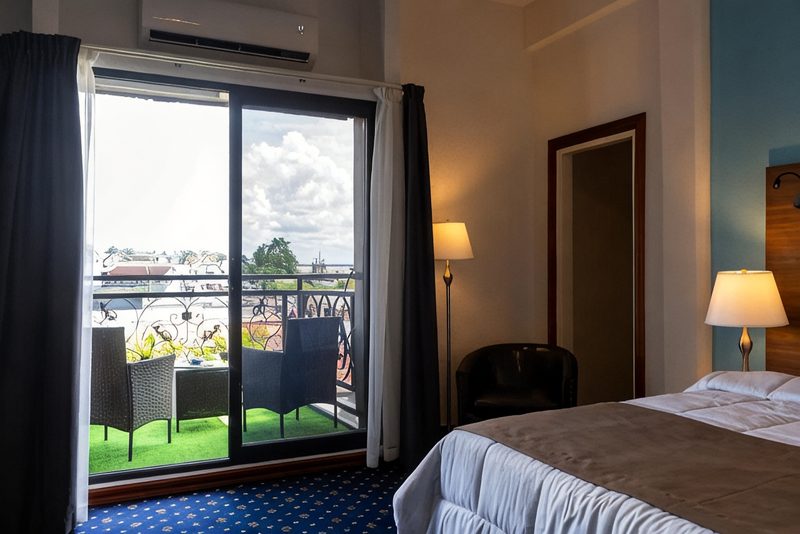
Hand-picked hotels across price tiers for February travellers.
Public Holidays in February
Dates that affect opening hours, transport and crowds
Chinese New Year
Observed nationwide as a public holiday.
Day of the Revolution
Observed nationwide as a public holiday.
Day of the Revolution
Observed nationwide as a public holiday.
Packing Checklist
Bookmark this page — your progress is saved between visits
Need the full list with shopping links?
Climate-specific gear, brand recommendations, and what to leave at home.
View Paramaribo Packing List →Essential Tips
Insider knowledge and common pitfalls to avoid
Insider Knowledge
Sranan Tongo, not Dutch, is the language that gets you places in Paramaribo. Fa waka, meaning how are you, and Mi lobi Sranan, meaning I love Suriname, will visibly change how market vendors and taxi drivers interact with you. Dutch is official and universally understood. But Sranan Tongo is the street language, the kitchen language, and the language of warmth. Even a few phrases signal that you see this country as more than a former colony.
The Waterkant comes alive after 6 PM on Friday and Saturday evenings in a way no guidebook captures. Families, couples, groups of teenagers, street vendors selling pinda soep and bakabana: this is Paramaribo's communal living room, and the energy is completely different from the daytime heritage-walk version of the same waterfront. If you want to understand how this city socializes, show up at sunset on a Friday, buy something from a food cart, sit on the seawall, and stay for a few hours.
Paramaribo runs on Surinamese time, which is to say loosely. If a tour departure is listed at 7 AM, plan for 7:30. If a restaurant opens at noon, it might be ready by 12:45. This is not disorganization. It is cultural pace. Fighting it will frustrate you. Adapting to it is one of the genuine pleasures of spending time here: the city moves at a rhythm that rewards patience, and the moments you stop checking your watch are the moments the place starts to open up.
The synagogue-mosque pairing on Keizerstraat is not just a photo opportunity. Congregation members from Neveh Shalom and the adjacent mosque have shared parking, coordinated service schedules, and maintained a neighborly relationship for over a century. If you visit on a weekday morning and ask respectfully, someone from either community will often walk you through the interior and share the history in a way no placard can. This is Paramaribo's character distilled into a single city block: improbable coexistence, practiced daily, without performance.
Avoid These Mistakes
Assuming you can pay with US dollars or euros everywhere. Suriname's currency is the Surinamese dollar, and while some tourist-facing businesses accept foreign currency, the exchange math is rarely in your favor and many places, including the Centrale Markt, operate cash-only in SRD. Change money at a licensed cambio in the inner city, not at the airport, where rates are worse.
Scheduling outdoor activities for the afternoon. February's rain pattern is predictable enough that locals plan around it instinctively: mornings are your window for walking tours, market visits, and photography, with clear skies and manageable temperatures. By 1 or 2 PM, cloud builds fast and the downpour hits between 2 and 5 PM on most days. Plan indoor time, a museum visit to Fort Zeelandia or a long lunch, for the wet hours, and resume outdoor plans by early evening.
Treating Paramaribo like a beach destination. The city sits on a muddy tidal river, not a coastline, and the nearest swimmable beaches are a considerable drive away. Travelers who arrive expecting white sand and turquoise water based on Suriname being in South America are confusing it with the Caribbean islands. The draw here is the city itself, the river, the interior jungle, and one of the most distinctive food cultures on the continent. Adjust expectations before you book, and you will not be disappointed.
Short on time? See day trips around Paramaribo on GetYourGuide.
Ready to plan your trip to Paramaribo?
Now that you've got the research covered, here's where to go next.
Explore More Activities in Paramaribo
Didn't see anything interesting yet?
Browse Viator's full catalog of tours, day trips, food experiences, and private guides in Paramaribo.
See All Paramaribo Tours on Viator