
Things to Do in Paramaribo in October
October weather, activities, events & insider tips
Low Season · Budget Friendly
October Weather in Paramaribo
Long-run averages for October
89°F (32°C)
High Temp
77°F (25°C)
Low Temp
3.4 inches (86 mm)
Rainfall
79%
Humidity
9
Rainy Days
12
Sunny-Day UV
⚠ UV exposure at this latitude is extreme year-round. October's partly cloudy skies create a false sense of safety. UV penetrates thin cloud cover at equatorial latitudes with minimal attenuation. Sunburn can develop in under 20 minutes on unprotected skin, and reflected UV on river boat tours effectively doubles your dose. SPF 50+ sunscreen, protective clothing, and a wide-brimmed hat are medical-grade necessities, not accessories. Protect yourself.
⚠ Mosquito-borne illness risk remains elevated in October. Standing water from the preceding long rainy season provides breeding habitat for Aedes aegypti mosquitoes that carry dengue and chikungunya. The interior regions south of Paramaribo also carry a low but real malaria risk. Consult a travel medicine provider before departure, use DEET repellent consistently, and sleep under a treated net if your accommodation lacks screened windows. Take precautions.
Making the most of October in Paramaribo? Browse tours and activities in Paramaribo on GetYourGuide.
Is October Right for You?
Weigh the advantages and considerations before booking
Advantages
- + October is the driest month on the calendar in Paramaribo, with only 86 mm (3.4 inches) of rain across roughly nine days. Compare that to May's 307 mm (12.1 inches) deluge and you start to understand why locals consider this the sweet spot. The short dry season opens up river travel, interior treks, and uninterrupted mornings along the Waterkant that the wet months simply cannot guarantee.
- + Tourist numbers in Suriname are thin year-round, but October thins them further. The UNESCO-listed historic inner city, the wooden cathedral, Fort Zeelandia, the synagogue-mosque pairing on Keizerstraat. You will likely have these places nearly to yourself on a Tuesday morning. No queues. No selfie sticks blocking sightlines. No inflated seasonal surcharges.
- + River conditions in October tend to be good for boat excursions. The Suriname River and Commewijne tributaries run calmer and clearer after the long rainy season has passed, which improves dolphin sighting odds near the estuary and makes plantation tours along the Commewijne far more comfortable. Boatmen will tell you October and September are their favorite working months.
- + The fruit season is still hanging on. Market stalls in the Centrale Markt on Waterkant overflow with markoesa (passion fruit), awara (a small orange palm fruit the Maroons stew into a thick, earthy sauce), and watermelon cut into dripping slabs that the vendors hand you on newspaper. Seasonal abundance means lower fruit prices at stalls and sharper flavors in everything from fresh juices to Javanese rujak.
Considerations
- − The heat is relentless and there is no altitude escape. Paramaribo sits at sea level in the equatorial belt, and October's average high of 32°C (89°F) arrives with 79% humidity that makes it feel closer to 38°C (100°F) by midday. Air conditioning is inconsistent outside newer buildings. The city simply does not cool down at night. Lows hover around 25°C (77°F), and ceiling fans in older guesthouses only redistribute warm air.
- − October falls in a quiet cultural stretch. Suriname's major celebrations; Holi Phagwa, Keti Koti on July 1st, the Maroon Day drumming. Land in other months. You are unlikely to stumble into a street festival or public holiday in October, which means the city's energy runs at its baseline rather than at a festive peak.
- − Mosquitoes are aggressive in the warm, still evenings, along the riverfront and in neighborhoods like Rainville where tree cover is dense. Dengue is a real concern in Suriname's coastal lowlands, and October's residual standing water from the preceding wet season keeps breeding sites active. DEET-based repellent and long sleeves at dusk are not suggestions. They are necessities.
Settled on October? Compare hotel prices in Paramaribo for your dates on Trip.com.
Best Activities in October
Top things to do during your visit
October hits Paramaribo's driest stretch. It is a welcome exhale after the drenching rains that soak the capital from April through July. Average highs reach 32°C (89°F) and lows settle around 25°C (77°F), with rainfall dropping to just 86 mm for the month, less than a third of what May delivers. The air still carries weight. The afternoons crack open into long, cloudless hours where the whitewashed timber facades along Waterkant glow almost painfully bright against the Suriname River. Walking the old Dutch colonial grid feels different now than it does in the wet months: the red laterite side streets have dried to a firm crust, the canal water runs lower and slower, and the tamarind trees along Grote Combéweg hold their leaves in full, unshredded canopy. This is the season when Paramaribo opens up for sustained outdoor time. The city rewards it. Evening life in Paramaribo shifts outdoors in October. Warung vendors along Waterkant set their charcoal grills earlier, and the sweet, fatty smoke of bami and saté drifts across the waterfront promenade well before sundown. The Javanese, Creole, Hindustani, and Maroon food stalls at the Centrale Markt are less frantic than during peak-rain months, when locals rush through their shopping between downpours, and more conversational, with sellers lingering over their displays of kousenband beans, bakkeljauw, and roti skins. Restaurants in the Torarica and Keizerstraat corridors set tables outside with some confidence that a squall will not send diners scrambling before dessert. For travelers arriving from elsewhere in South America or the Caribbean, the scale of Paramaribo surprises: the UNESCO-listed wooden inner city is walkable in an afternoon, the nightlife concentrates along a few reliable blocks near Dominéstraat, and the surrounding jungle and wetland systems sit close enough for genuine day excursions. October's lower rainfall makes those excursions far more practical than attempting them in the sodden heart of the wet season.

Paramaribo City Tour
guided_experienceThe Paramaribo City Tour covers the full sweep of the capital's colonial, religious, and market life in a single guided loop. You move from the towering wooden Cathedral of Saints Peter and Paul, where the interior smells of aged tropical hardwood and candle wax, to the Neveh Shalom synagogue standing shoulder to shoulder with the Ahmadiyya Anjuman mosque on Keizerstraat, a proximity that exists almost nowhere else on earth. The tour threads through the Centrale Markt, where the clatter of cleavers on cutting boards competes with vendors calling out prices for fresh pompoen and cassava, and along Waterkant, where the creaking wooden warehouses face the broad, tidal river.
The only efficient way to decode how Dutch planters, Javanese contract workers, Hindustani merchants, Maroon communities, and Sephardic Jews built a single city whose architecture and food reflect every chapter.
Insider tip: Ask your guide to detour through the Palmentuin, the palm garden behind the Presidential Palace, where the afternoon heat breaks under the royal palm canopy and you can hear green parrots overhead rather than traffic.
This month: October's dry conditions mean the walking segments stay comfortable and the wooden heritage buildings, which darken and streak badly under heavy rain, photograph cleanly.

Full-Day Brownsberg Nature Park Tour
day_tripThe Full-Day Brownsberg Nature Park Tour takes you an hour and a half south of Paramaribo and roughly 500 meters up onto a laterite plateau overlooking the Brokopondo Reservoir, a vast artificial lake ringed by unbroken primary rainforest. The trail to Mazaroni Falls drops through dense canopy where howler monkeys groan from somewhere above and the air turns cool and damp, thick with the smell of wet leaf litter and decaying wood even in the dry season. At the falls themselves, the water spills over a dark rock ledge into a pool cold enough to shock after the humid hike, and the mist catches light in a way that makes the surrounding ferns almost luminous.
Brownsberg is the most accessible primary rainforest experience from Paramaribo, delivering genuine jungle, waterfalls, and wildlife without the multi-day river journey that the deep interior demands.
Insider tip: Wear shoes with aggressive tread, not trail runners. The laterite clay on the Mazaroni trail stays slick even in dry weeks, and the descent to the falls is steep enough that a slip means a real tumble.
This month: October's reduced rainfall means the trails are drier and more stable than during the wet season, and the reservoir viewpoint is less likely to be obscured by low cloud, though the waterfalls still carry enough flow to be worth the hike.

Sunset and Dolphin Tour Suriname
guided_experienceThe Sunset and Dolphin Tour launches from the waterfront as the afternoon light begins to soften, heading downriver toward the estuary where the Suriname River meets the Atlantic. Guiana dolphins surface in loose groups here, their grey backs rolling through tannin-dark water that catches the last copper and pink bands of equatorial sunset. The boat engine cuts. For a few minutes the only sounds are the slap of small waves against the hull, the occasional explosive exhale of a surfacing dolphin, and the calls of scarlet ibises heading to roost in the mangroves along the far bank.
This is the rare wildlife encounter that costs a single evening rather than a multi-day expedition, and the combination of river dolphins and equatorial sunset seen from the water gives Paramaribo a dimension most visitors never find on foot.
Insider tip: Sit on the port side of the boat for the best sunset angle, and bring a lightweight rain shell rather than an umbrella. Even in dry October, the river breeze picks up spray at speed and the return trip runs into cooler air.
This month: October's clearer skies produce more dramatic sunsets than the overcast evenings common during the wet months, and calmer river conditions improve dolphin visibility at the surface.

Bigi Pan Tourist Eco Lodge
guided_experienceBigi Pan Tourist Eco Lodge sits on the edge of the Bigi Pan wetland system west of Paramaribo, a 60,000-hectare expanse of mangrove forest, brackish lagoons, and mudflats that constitutes one of the most important waterbird habitats on South America's Atlantic coast. At dawn the shallow lagoons turn a metallic silver under low light, and the noise is extraordinary: the guttural croaking of herons, the whistling of black-bellied tree ducks, and the distant honking of scarlet ibises arriving in staggered flights to feed. The lodge itself is basic but functional, raised on stilts above the waterline, and the smell of the surrounding mangroves, a briny, organic tang like a salt marsh amplified, is inescapable and oddly pleasant.
Bigi Pan holds the densest concentration of scarlet ibises in Suriname, and the eco lodge puts you directly inside the wetland rather than at its edge, eliminating the long boat commute that day-trippers face.
Insider tip: Bring binoculars with at least 8x magnification and a headlamp for the pre-dawn boat departure. The guides leave early to reach the ibis feeding grounds at first light, and fumbling in the dark on a narrow dock is a poor start.
This month: October's position in the dry season means water levels in the Bigi Pan lagoons are lower, concentrating birds into smaller feeding areas and making sightings denser and more reliable than during the flooded wet months.
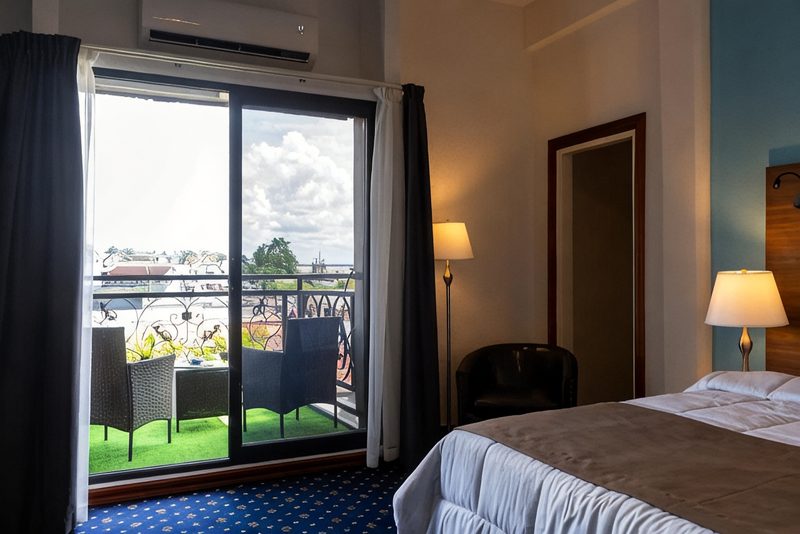
Where to Stay in Paramaribo in October
Hand-picked hotels across price tiers for October travellers.
Public Holidays in October
Dates that affect opening hours, transport and crowds
Day of the Maroons
Observed nationwide as a public holiday.
Chinese Arrival day
Observed nationwide as a public holiday.
Day of the Maroons
Observed nationwide as a public holiday.
Chinese Arrival day
Observed nationwide as a public holiday.
Day of the Maroons
Observed nationwide as a public holiday.
Chinese Arrival day
Observed nationwide as a public holiday.
Packing Checklist
Bookmark this page — your progress is saved between visits
Need the full list with shopping links?
Climate-specific gear, brand recommendations, and what to leave at home.
View Paramaribo Packing List →Essential Tips
Insider knowledge and common pitfalls to avoid
Insider Knowledge
Learn five phrases in Sranan Tongo. Skip polishing your Dutch. Suriname's official language is Dutch. On the street, in the market, in any casual setting, Sranan Tongo is what people speak. 'Fa waka?' (how's it going), 'Mi na wan toerist' (I'm a tourist), 'San na prijs?' (what's the price). These open doors that formal Dutch keeps shut. Market vendors respond to Sranan with visible warmth. It signals you bothered to learn something real about where you are.
The Waterkant waterfront transforms after 5 PM. During the day it is a hot, mostly empty promenade where river smell dominates. As the sun drops and temperature eases from unbearable to merely warm, families appear. Food vendors set up along the railing. Benches fill with people watching river traffic. This is when Paramaribo feels most like itself. Unhurried. Social. Unperformative. The sunset from the Waterkant, with the river turning copper and the ferry crossing silhouetted against it, is the single best free experience in the city. Do not miss it.
Paramaribo's food is its best-kept advantage over every other capital in the region. It is not close. The Javanese, Hindustani, Creole, Chinese, and Maroon kitchens operate independently. Their craft comes from generations of community cooking, not restaurant ambition. The Hindustani roti shops in the Blauwgrond neighborhood wrap curried potato, egg, and slow-cooked chicken inside a single enormous flatbread. The dough tears with a snap. The curry underneath is turmeric-yellow and thick enough to hold its shape. Eat where locals queue. Skip the English signage.
Do not attempt to drive yourself outside Paramaribo. The interior roads to Brownsberg or southward toward the Maroon territories are unpaved, poorly signed, and occasionally washed out even in October's dry conditions. Roadside assistance does not exist once you leave the coastal zone. Local operators with vehicles and drivers who know the roads are not a luxury. They are basic logistics. Save the rental car for the city if you need one at all. Paramaribo's center is compact enough to walk.
Avoid These Mistakes
Avoid scheduling outdoor activities between 11 AM and 3 PM. First-time visitors from temperate climates consistently underestimate equatorial midday heat. At 32°C (89°F) with 79% humidity and near-vertical sun, your body loses water faster than thirst signals can track. Locals retreat indoors during these hours for a reason. Plan your market visit, walking tour, and riverfront time for early morning or late afternoon. Use midday for air-conditioned museums like the Surinaams Museum in Fort Zeelandia. Or simply rest at your accommodation.
Do not assume Paramaribo is a beach destination. The Suriname coast is river delta: muddy, mangrove-lined, and not suited for swimming in the way Caribbean or Pacific beaches are. Travelers expecting white sand and turquoise water will be disappointed immediately. Paramaribo's appeal is its wooden city, its river, its food cultures, and its access to interior rainforest. Not its coastline. Adjust expectations before you book. You will have a far better trip.
Do not carry only US dollars or euros and expect to pay everywhere. Some guesthouses and tour operators accept foreign currency. The Centrale Markt, local warungs (Javanese food stalls), water taxis, and any transaction outside the tourist corridor requires Surinamese dollars. Exchange rates at official cambios downtown tend to be significantly better than at the airport. Carry enough local cash for two days of eating and transport at a time. Keep large bills separate from your daily spending money.
Short on time? See day trips around Paramaribo on GetYourGuide.
Ready to plan your trip to Paramaribo?
Now that you've got the research covered, here's where to go next.
Explore More Activities in Paramaribo
Didn't see anything interesting yet?
Browse Viator's full catalog of tours, day trips, food experiences, and private guides in Paramaribo.
See All Paramaribo Tours on Viator